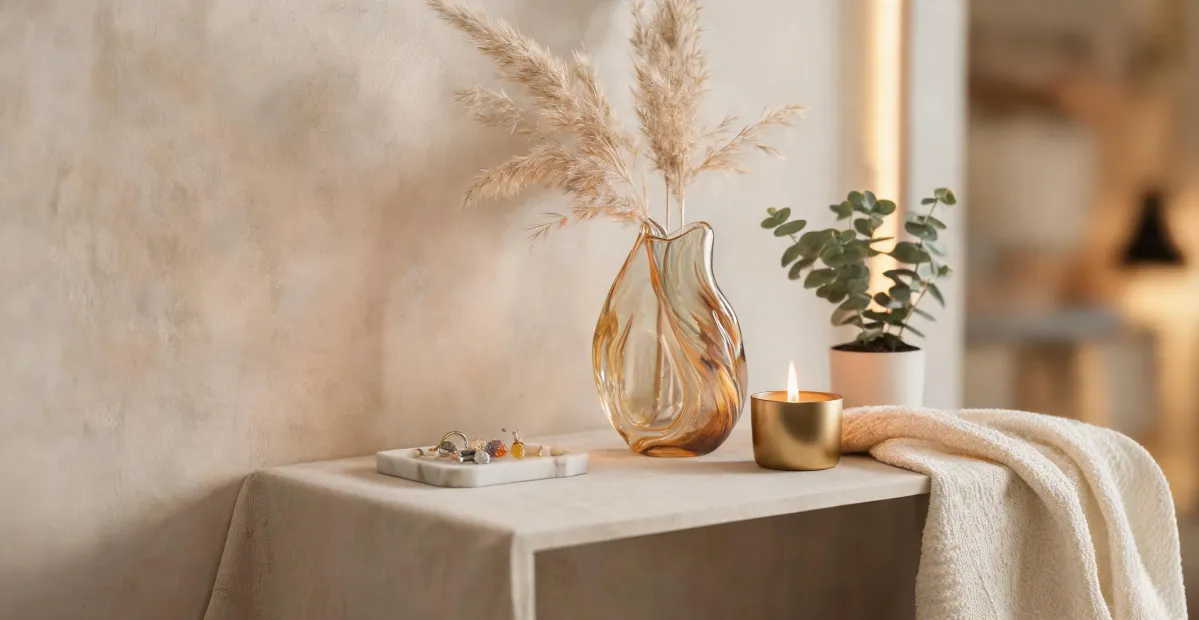
Yes, Simon Pearce belongs in a corporate gifting program—provided you're looking at total cost per delivered gift, not the product page price. I've spent seven years managing the client-gift budget for a 200-person marketing firm, around $60,000 a year, and I've tracked every purchase in our cost system. The Romance Vase and the candle holders are two of the few items that keep getting ordered after the novelty wears off. The Christmas ornaments are the best low-cost entry point. And the 'crystal vase' question comes up more than you'd think, so I'll settle it below.
The key number that changed my buying
Our 2023 audit showed that 17% of our glassware gift spend was going to breakage, returns, and re-shipping—not to the glass itself. That's huge. It meant the actual cost of a $38 vase was often closer to $54 once I added replacement pieces, rush shipping, and the time it took my assistant to manage the 'it arrived shattered' emails. A $55 vase that arrives intact is cheaper than a $38 vase that doesn't. Period.
This is why I stopped using unit price as my first filter. Now I estimate the total cost: product + packaging + shipping + expected breakage + handling time. When I apply that, Simon Pearce's premium pricing looks different. The glass is heavy. Heavy glass feels expensive. It also needs more shipping protection, but in our tests it arrived in good shape at a very high rate. The pieces that broke were almost always the ones where we tried to use lighter packaging.
What I actually order
The Simon Pearce Romance Vase
If a client is in banking, architecture, or any place where 'subtle but noticeable' matters, the Romance Vase is my default. It's not a showpiece that demands a mantle. It sits on a conference table and makes everyone think someone took time to choose it. From a procurement standpoint, the stable base is what matters. We've never had one tip over in an office setting. That's rare enough for a vase that I notice.
The opening isn't so wide that a standard flower delivery disappears, which means the gift doesn't require a florist. That cuts my total cost further. A vase that needs a $90 arrangement to look good isn't a $68 gift; it's a $158 gift. This one doesn't have that problem.
Simon Pearce candle holders
I keep a handful of Simon Pearce candle holder styles in our internal catalog. They're a good middle ground: less fragile than a stemmed vase, but still clearly a considered gift. The heavy glass base does the work; it makes the whole piece feel grounded. I've shipped these to a lot of home offices, and they don't look out of place next to a laptop or on a bookshelf.
Christmas ornaments
For clients with a bigger contact list, ornaments are the most underrated entry point. They're small, they ship in individual boxes, and they don't need the same custom packaging as a vase. As of January 2025, a First-Class Mail letter costs $0.73 according to USPS, but an ornament is not a letter—it's a fragile package. If you budget for a package, you'll be fine. The point is, an ornament is one of the few premium gifts that still fit in a standard shipping box. That keeps the TCO down while the perceived value stays up.
The 'crystal vase' question
A surprising number of people search for 'crystal vase' and end up looking at Simon Pearce. Let me give you the procurement version: if you need traditional lead crystal, Simon Pearce is not that. The brand is handblown glass. It has a clarity and ring that reads as crystal, but it's not crystal in the lead-content sense. If you're shopping by category, put it in the same visual tier as crystal, but don't send your client a note that says 'leaded crystal.' You'll start a conversation you don't want.
Can you burn a candle in a Mason jar?
Because one of my clients asked for the 'rustic candle jar' look, here's the short answer: not with a standard canning jar. A Mason jar is designed for canning, not for an open flame. It can handle hot water, but a candle flame creates a focused heat source that can stress the glass until it cracks. If you want to burn a candle in a Mason jar, buy a candle that a candle maker specifically put in a heat-safe jar. Don't pour wax into a leftover Ball jar and light it. Period.
This might sound unrelated to procurement, but it's exactly the kind of hidden liability I track. A candle container that cracks in a client's office is a relationship problem, not just a product defect. Simon Pearce candle holders are designed for candle use, which is part of why I don't buy decorative jars from unknown suppliers.
Why I keep coming back
The industry has changed since I started buying gifts. In 2020, a branded tech gadget was the default. By 2025, it's the opposite. Clients are tired of another logo tumbler. They want something that doesn't scream 'swag.' A handblown vase or a Christmas ornament doesn't need a logo to say you thought about the person. The fundamentals haven't changed—a gift should be appropriate and memorable—but the execution has transformed. Simon Pearce fits the newer version of that rule.
I'm also careful about claims. Per FTC guidelines, marketing claims need to be truthful and substantiated. That's why I don't buy 'eco-friendly' glass from brands that can't tell me how. Simon Pearce doesn't overstate it. The product is handmade and made to last. That's a claim you can observe without a lab report.
Custom branding? If you want your company color etched into glass, don't expect Pantone-level color matching on a curved surface. The standard tolerance for brand colors is Delta E under 2 for flat printed materials, but glass is curved and reflective. A logo will look better on a flat print piece than on a vase. Plan around that.
The test order story
Here's the risk-weighing part. Last year, a supplier quoted us 22% less for similar-looking glassware. The upside was obvious: about $8,600 in annual savings. The risk was that a client would open a malformed vase with our company note inside. I calculated the worst case—a client's VP sees a bent, bubble-heavy vase and thinks we don't care. The best case was saving money. The expected value said switch. The downside felt too big.
We compromised. We ran a test order instead of an annual contract. The quality was inconsistent. Some pieces were fine, some had visible asymmetry, and one 'handmade' label didn't match the actual product. The order cost us $1,250 in rework and rerouting. That's exactly the kind of hidden cost that doesn't show up in a quote. Now our procurement policy requires three quotes, and I calculate TCO before any vendor switch. It's not because the cheaper supplier was evil. It's because I was too quick to listen to the unit-price brain.
I had my own overconfidence moment too. We'd had a perfect order from a craft warehouse, so the next time I skipped double-boxing the heavy candle holders. I told myself 'they've packed glass since they started.' Two bases arrived cracked. $170 in product and shipping, gone. Not the vendor's fault—mine. It went into the cost file as a reminder.
When I would not buy Simon Pearce
If you need 500 identical vases in two weeks, or if your budget per gift is under $30, this is not your answer. Handblown glass has variation; that's the point, but it makes 'identical' hard. Also, if a decision-maker expects the cheapest possible gift, Simon Pearce will be a hard sell. That's okay. The brand doesn't need to win every order.
For most corporate gifting, though, the TCO math works. The Romance Vase and candle holders sit in our rotation for one simple reason: they actually get used. A vase that gets used is a vase that gets noticed. An ornament that hangs on a tree for ten years is a gift that cost a few dollars a year. That's a return I can justify in a budget meeting.
