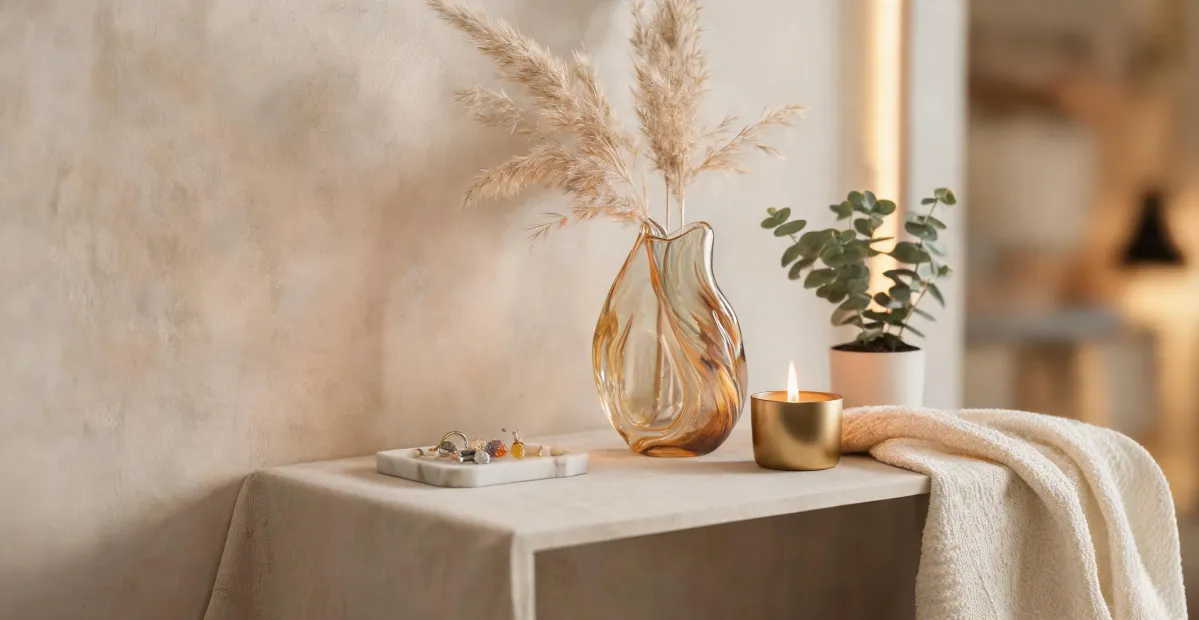
I coordinate corporate gift orders at Simon Pearce. That means I take the calls that start with a nervous email and the question, How soon can we get it by? Over the last eight years, I have worked through close to 200 rush orders, from 25 sales kickoff gifts to a 300-piece holiday shipment. The decision I help with most often is vase or figurine.
Before I compare them, one terminology note. Customers often type crystal vase into a search box when they mean a formal glass vase. Simon Pearce makes lead-free, handblown glass, not traditional lead crystal. The two are not identical. But the practical choice for a corporate gift is the same: do you send a vase, or do you send a handblown glass figurine such as the Simon Pearce Christmas Tree?
I use four criteria, in this order:
- Will it earn a visible spot?
- Does it communicate the right level of respect?
- Can we ship it intact by the deadline?
- Will it stay in the recipient's mind next year?
1. Will it earn a visible spot?
A vase is a beautiful gift for someone who buys flowers. If the recipient is a busy executive who never gets to a florist, a vase is an empty job waiting for an arrangement. It ends up in a cabinet, which is basically the same as being regifted, just quieter.
A glass figurine does not ask for a support system. The Simon Pearce Christmas Tree, for example, can sit on a credenza, a mantel, or an office shelf and look complete on day one. No water. No stems. No upkeep.
Conclusion: if you do not know the recipient's flower habits, a glass figurine has less display friction. A vase is a better bet when you know the person builds flower arrangements for fun.
2. Does it feel like the right amount of respect?
If the gift is for a C-level client, a vase has a legitimate advantage. It takes up space. It catches light. When they open the box, it feels substantial. That is not unimportant in a formal relationship.
A glass figurine is often more personal, but it can be undersold if it arrives without context. You have to be willing to let the story travel with the gift. Once that happens, it changes the reaction. I have mixed feelings about figurines because part of me still hears the procurement director who wants something impressive. Another part of me has watched a handblown glass tree make a CFO stop and ask where it came from.
Conclusion: a vase says respect. A figurine says memory. Which does your client need?
3. Can it survive a tight deadline?
This is the part that gets overlooked until the event gets moved up. A large vase is a larger box, more foam, more empty space, more dimensional weight. It can be shipped safely, but every extra inch matters when you are sending 60 gifts to four cities with two days in hand. Breakage is not the only enemy; so is the cost of express freight on oversized packages.
A glass figurine is easier to pack and insulate. Smaller boxes fit into a courier network more efficiently. Breakage risk never reaches zero, but my experience says smaller pieces survive the last mile better than large open forms.
I still kick myself for approving a rush order of 60 vases in 2023. Four arrived cracked, and we had to scramble for replacements before the client event. We made it work, but the lesson stuck. Our internal rule now is to keep a 48-hour buffer on any freight shipment, and to use smaller pieces when the calendar leaves no margin.
4. Will they remember the giver next year?
A vase is timeless. That is an advantage when you need a gift that works in February, June, or October. It is a slightly smaller advantage when you are sending Christmas gifts in November, because the vase goes on a shelf and blends into the background by February.
A seasonal glass piece works differently. The Simon Pearce Christmas Tree is taken out, dusted, set on the mantel for a few weeks, and carefully packed away. Every year, when that piece comes out again, your company name comes back with it. That is the counterintuitive part: a seasonal gift can have a longer memory span than a year-round gift because it has a built-in annual reminder.
Conclusion: if the goal is to be remembered every holiday season, a Christmas tree figurine is a stronger choice than a vase. If the goal is a one-time thank-you, a vase is perfectly fine.
Bonus: how long does it take to melt candle wax?
If you add candles to a glass gift, someone will inevitably ask the question. How long does it take to melt candle wax? The rule of thumb is about one hour of burn time for every inch of container diameter. A normal 3-inch candle should therefore reach a full melt pool in roughly two to three hours. A narrow votive can do it in 90 minutes. A wider candle may take closer to four hours.
Why this matters: if you blow the candle out before the whole top surface has melted, the wax forms a tunnel around the wick and the rest of the candle wastes away. The first full melt creates the candle's memory. And please trim the wick to about 1/8 inch before each lighting. That is not candle polish; it prevents the flame from getting tall and sooty.
Vase or figurine: the playbook
Here is how I make the call when the deadline is pressing.
Choose a vase if
- The recipient is at executive level and the relationship is formal.
- You know that person puts fresh flowers in a vase.
- You need a non-seasonal gift that cannot feel out of place.
- You have at least a week and can handle a larger, more fragile package.
Choose a handblown glass figurine if
- The message should feel personal rather than ceremonial.
- The recipient has a small office or a cluttered home.
- The deadline is short and multiple locations are involved.
- You want to build a holiday tradition: the Simon Pearce Christmas Tree is a good example.
One caveat: my experience is mainly with orders of 25 to 300 pieces for professional services and technology companies. If your world is hospitality, retail, or a very different gifting culture, test your assumptions before you commit.
Bottom line: there is no universal best option. A vase is safer; a figurine is stickier. Choose based on the outcome you need, not on which piece photographs better on a website.